Abstract/Summary
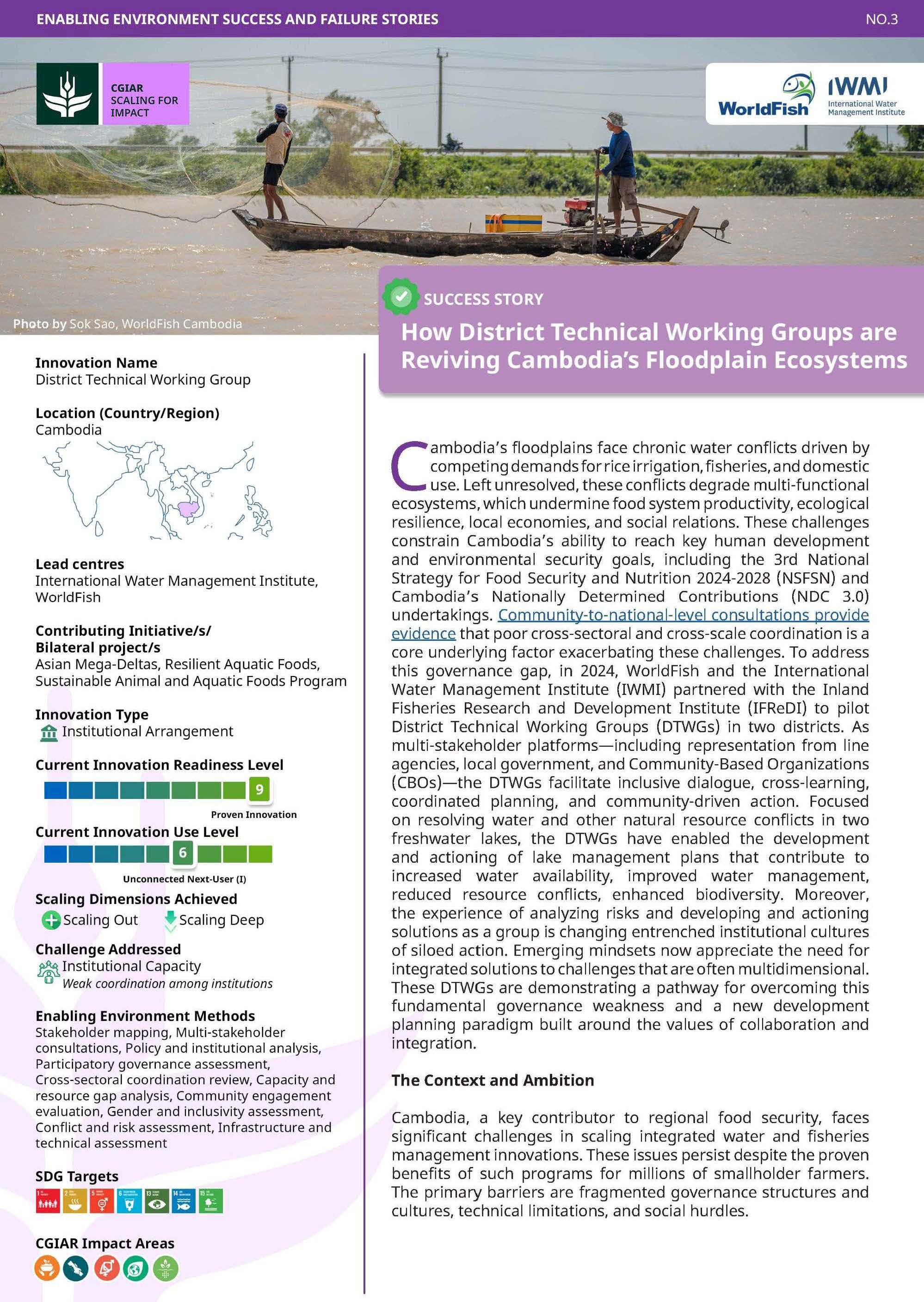
Cambodia’s floodplains face chronic water conflicts driven by competing demands for rice irrigation, fisheries, and domestic use. Left unresolved, these conflicts degrade multi-functional ecosystems, which undermine food system productivity, ecological resilience, local economies, and social relations. These challenges constrain Cambodia’s ability to reach key human development and environmental security goals, including the 3rd National Strategy for Food Security and Nutrition 2024-2028 (NSFSN) and Cambodia’s Nationally Determined Contributions (NDC 3.0) undertakings. Community-to-national-level consultations provide evidence that poor cross-sectoral and cross-scale coordination is a core underlying factor exacerbating these challenges. To address this governance gap, in 2024, WorldFish and the International Water Management Institute (IWMI) partnered with the Inland Fisheries Research and Development Institute (IFReDI) to pilot District Technical Working Groups (DTWGs) in two districts. As multi-stakeholder platforms—including representation from line agencies, local government, and Community-Based Organizations (CBOs)—the DTWGs facilitate inclusive dialogue, cross-learning, coordinated planning, and community-driven action. Focused on resolving water and other natural resource conflicts in two freshwater lakes, the DTWGs have enabled the development and actioning of lake management plans that contribute to increased water availability, improved water management, reduced resource conflicts, enhanced biodiversity. Moreover, the experience of analyzing risks and developing and actioning solutions as a group is changing entrenched institutional cultures of siloed action. Emerging mindsets now appreciate the need for integrated solutions to challenges that are often multidimensional. These DTWGs are demonstrating a pathway for overcoming this fundamental governance weakness and a new development planning paradigm built around the values of collaboration and integration.
Open access: https://hdl.handle.net/10568/178453
Related Publications
From Serial Discontinuity to Socio-ecological Resilience: A Conceptual...
08-Oct-2026
River ecosystem discontinuity and dysconnectivity are significant concern in transboundary river basins. Anthropogenic i...
The Political Ecologies of Managing Cambodia’s Tonle Sap Fisheries
11-Aug-2026
Situated in Cambodia, the Tonle Sap Lake (TSL) is the largest freshwater lake in Southeast Asia and the Mekong River Bas...
Hydrological Dynamics and Implications for Integrated Water Resources...
04-Aug-2026
Boeng Sneh Lake (BSL), a 3,924-hectare freshwater wetland in Cambodia’s Mekong Delta, is a critical water resource tha...