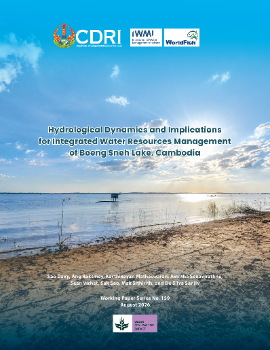
Hydrological Dynamics and Implications for Integrated Water Resources Management of Boeng Sneh Lake, Cambodia
Boeng Sneh Lake (BSL), a 3,924-hectare freshwater wetland in Cambodia’s Mekong Delta, is a critical water resource that supports agriculture, domestic water supply, fisheries, biodiversity conservation, and flood regulation. This study assessed the lake’s hydrological dynamics and their implications for Integrated Water Resources Management (I...
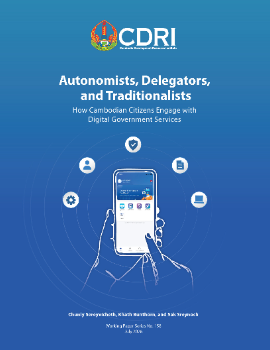
Autonomists, Delegators, and Traditionalists: How Cambodian Citizens Engage with Digital Government Services
This working paper presents a nationally representative analysis of how Cambodian citizens engage with digital government services. Drawing on a survey of 1,200 adults across 12 provinces, the study examines the extent of digital service use, identifies distinct modes of engagement, and assesses the factors associated with citizens' interaction...
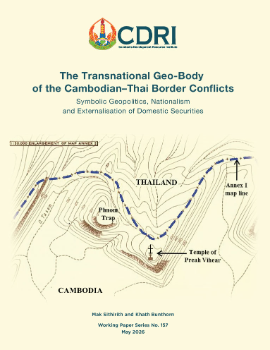
The Transnational Geo-Body of the Cambodian–Thai Border Conflicts: Symbolic Geopolitics, Nationalism and Externalisation of Domestic Securities
The Cambodian–Thai border conflict reoccurred in 2025. This article analyses these conflicts through the frameworks of transnational geo-body, built on the concepts of geo-body and imagined communities, to examine why colonial boundaries and symbolic sites along the Cambodian–Thai borders have been transnationalised to shape recurring border co...
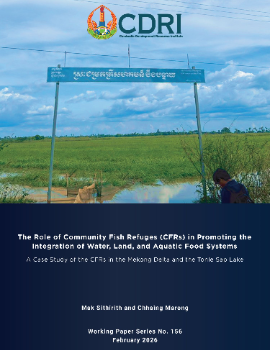
The Role of Community Fish Refuges (CFRs) in Promoting the Integration of Water, Land, and Aquatic Food Systems: A Case Study of the CFRs in the Mekon...
This working paper examines the role of Community Fish Refuges (CFRs) in promoting the integration of water, land, and aquatic food systems in Cambodia, drawing on six case studies in the Tonle Sap floodplain and Mekong Delta. Situated within rice-field and floodplain landscapes, CFRs function as dry-season refuges, wet-season spawning grounds,...
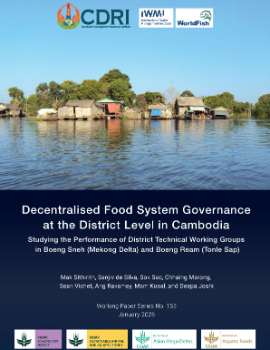
Decentralised Food System Governance at the District Level in Cambodia: Studying the Performance of District Technical Working Groups in Boeng Sneh (M...
This working paper examines decentralised food system governance at the district level in Cambodia through an assessment of District Technical Working Groups (DTWGs) established in Boeng Sneh (Mekong Delta) and Boeng Ream (Tonle Sap). These floodplain ecosystems are critical for rice production, fisheries, and rural livelihoods but face increas...
STEM Teachers’ Continuous Professional Development: Opportunities, Challenges, and Policy Implications in Cambodia
As Cambodia aims to become an upper-middle-income country by 2050, STEM education is recognised as a pivotal element in this transformation. However, significant challenges impede educational development, including a shortage of qualified STEM teachers, insufficient training, and limited resources. In this regard, this study addresses the press...
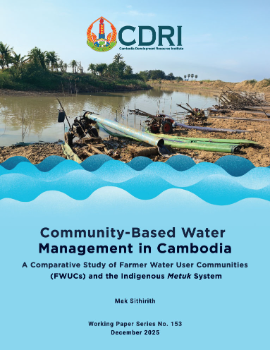
Community-Based Water Management in Cambodia: A Comparative Study of Farmer Water User Communities (FWUCs) and the Indigenous Metuk System
This working paper examines community-based water management in Cambodia through a comparative analysis of Farmer Water User Communities (FWUCs) and the indigenous Metuk system in the Tonle Sap floodplain. Drawing on qualitative case studies from Kakaoh Commune in Kampong Thom Province and Santey Village in Siem Reap Province, the study analyse...
Firm-Level Performance in Cambodia: An Economic Census-Based Diagnostics
Cambodia’s enterprise landscape remains structurally dualistic, characterised by an extensive base of micro and informal firms coexisting with a narrow segment of large, often foreign-owned enterprises. Using the Economic Census of Cambodia 2022, this study examines the determinants of firm performance and the structural conditions shaping business...
Building Resilience in the Geoeconomic Fragmentation: The Role of Transitioning MFIs to Banks in Cambodia’s Financial Development
In a geoeconomic fragmentation, Cambodia’s financial sector faces the urgent challenge of enhancing inclusion while safeguarding stability. The transition of microfinance institutions (MFIs) into banks marks a potential pivotal step toward resilience, offering opportunities to expand financial inclusion and absorb external shocks. This study an...

Enhancing the Collaboration between TVET Institutions and the Private Sector in Cambodia: Implications for Skills Provision
This study investigates the forms, benefits, and challenges of collaboration between technical and vocational education and training (TVET) institutions and the private sector in Cambodia. Drawing on qualitative data from 72 interviews with firms, training providers, government bodies, industry associations, and labour unions, the research explores...