
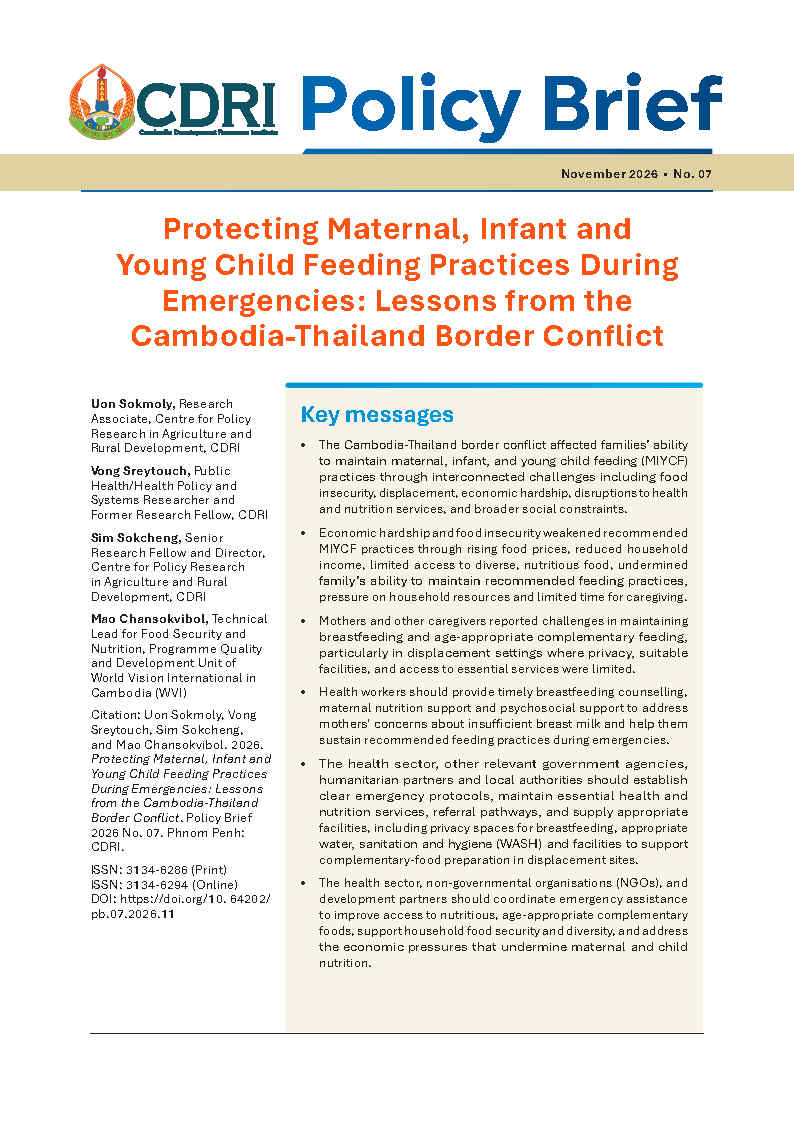
Protecting Maternal, Infant and Young Child Feeding Practices During Emergencies: Lessons from the Cambodia-Thailand Border Conflict
Keyword: Cambodia-Thailand border conflict, economic hardship, food insecurity, Maternal, Infant and Young Child Feeding (MIYC), public health
Abstract/Summary
- The Cambodia-Thailand border conflict affected families’ ability to maintain maternal, infant, and young child feeding (MIYCF) practices through interconnected challenges including food insecurity, displacement, economic hardship, disruptions to health and nutrition services, and broader social constraints.
- Economic hardship and food insecurity weakened recommended MIYCF practices through rising food prices, reduced household income, limited access to diverse, nutritious food, undermined family’s ability to maintain recommended feeding practices, pressure on household resources and limited time for caregiving.
- Mothers and other caregivers reported challenges in maintaining breastfeeding and age-appropriate complementary feeding, particularly in displacement settings where privacy, suitable facilities, and access to essential services were limited.
- Health workers should provide timely breastfeeding counselling, maternal nutrition support and psychosocial support to address mothers' concerns about insufficient breast milk and help them sustain recommended feeding practices during emergencies.
- The health sector, other relevant government agencies, humanitarian partners and local authorities should establish clear emergency protocols, maintain essential health and nutrition services, referral pathways, and supply appropriate facilities, including privacy spaces for breastfeeding, appropriate water, sanitation and hygiene (WASH) and facilities to support complementary-food preparation in displacement sites.
- The health sector, non-governmental organisations (NGOs), and development partners should coordinate emergency assistance to improve access to nutritious, age-appropriate complementary foods, support household food security and diversity, and address the economic pressures that undermine maternal and child nutrition.
Related Publications
Reintegrating Cambodia’s Return Migrants: Gender, Employment, and Live...
31-Aug-2026
Women with children in their households are significantly more likely to be unemployed, highlighting the dis...
Women-Led Groups as Pathways to Women’s Empowerment and One Health Pra...
14-Aug-2026
Women play a vital role in Cambodian agriculture, yet their leadership, decision-making power, access to knowledge, and...
Breaking the Vulnerability Trap: A One Health Approach to Rural Resili...
28-Apr-2026
Institutionalising the One Health approach within national agricultural extension services can significantly strengthen...