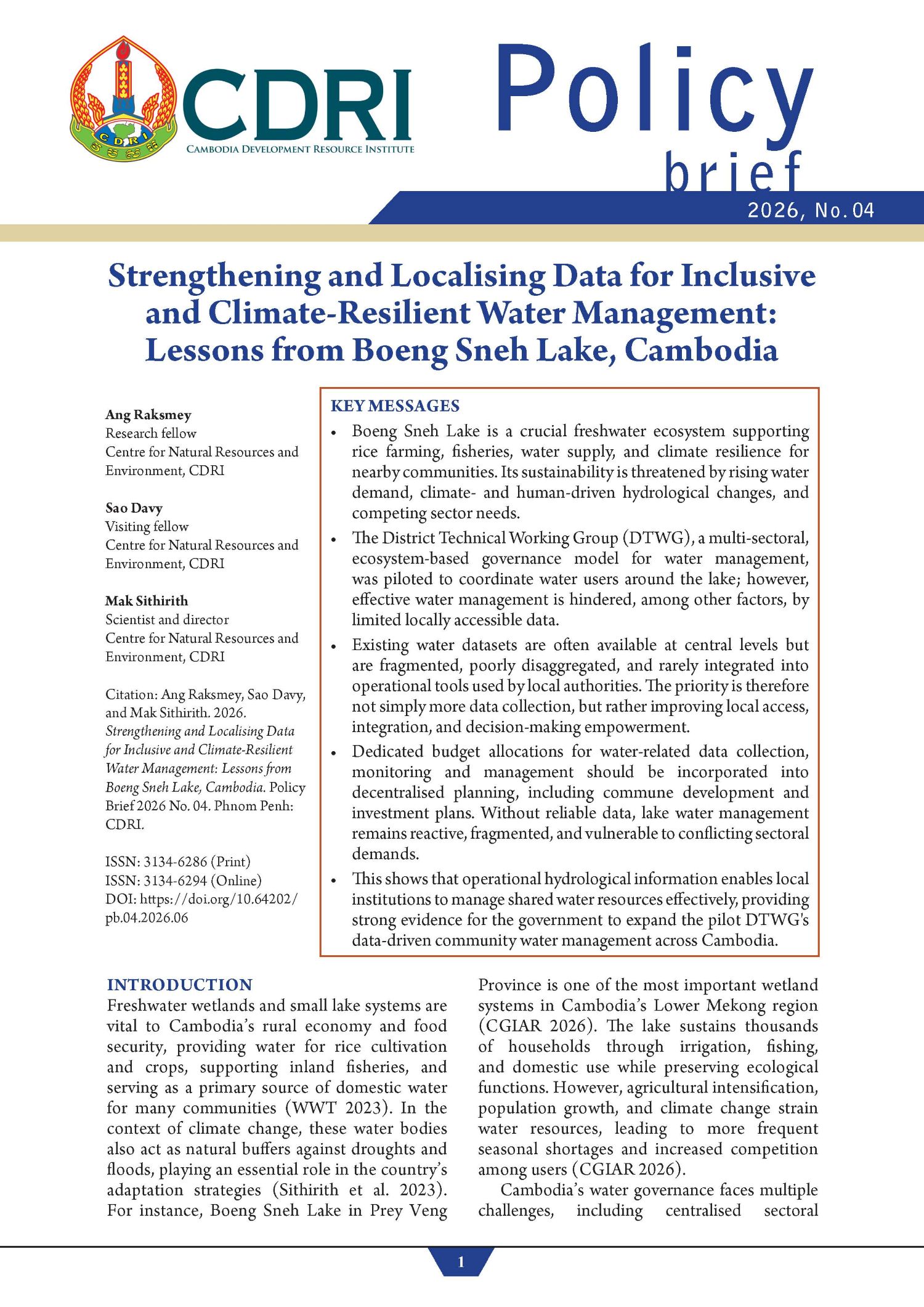
Strengthening and Localising Data for Inclusive and Climate-Resilient Water Management: Lessons from Boeng Sneh Lake, Cambodia
Keyword: Boeng Sneh Lake, climate resilience, District Technical Working Group, hydrological data, water management,
Abstract/Summary
- Boeng Sneh Lake is a crucial freshwater ecosystem supporting rice farming, fisheries, water supply, and climate resilience for nearby communities. Its sustainability is threatened by rising water demand, climate- and human-driven hydrological changes, and competing sector needs.
- The District Technical Working Group (DTWG), a multi-sectoral, ecosystem-based governance model for water management, was piloted to coordinate water users around the lake; however, effective water management is hindered, among other factors, by limited locally accessible data.
- Existing water datasets are often available at central levels but are fragmented, poorly disaggregated, and rarely integrated into operational tools used by local authorities. The priority is therefore not simply more data collection, but rather improving local access, integration, and decision-making empowerment.
- Dedicated budget allocations for water-related data collection, monitoring and management should be incorporated into decentralised planning, including commune development and investment plans. Without reliable data, lake water management remains reactive, fragmented, and vulnerable to conflicting sectoral demands.
- This shows that operational hydrological information enables local institutions to manage shared water resources effectively, providing strong evidence for the government to expand the pilot DTWG's data-driven community water management across Cambodia.
Related Publications
From Serial Discontinuity to Socio-ecological Resilience: A Conceptual...
08-Oct-2026
River ecosystem discontinuity and dysconnectivity are significant concern in transboundary river basins. Anthropogenic i...
The Political Ecologies of Managing Cambodia’s Tonle Sap Fisheries
11-Aug-2026
Situated in Cambodia, the Tonle Sap Lake (TSL) is the largest freshwater lake in Southeast Asia and the Mekong River Bas...
Hydrological Dynamics and Implications for Integrated Water Resources...
04-Aug-2026
Boeng Sneh Lake (BSL), a 3,924-hectare freshwater wetland in Cambodia’s Mekong Delta, is a critical water resource tha...