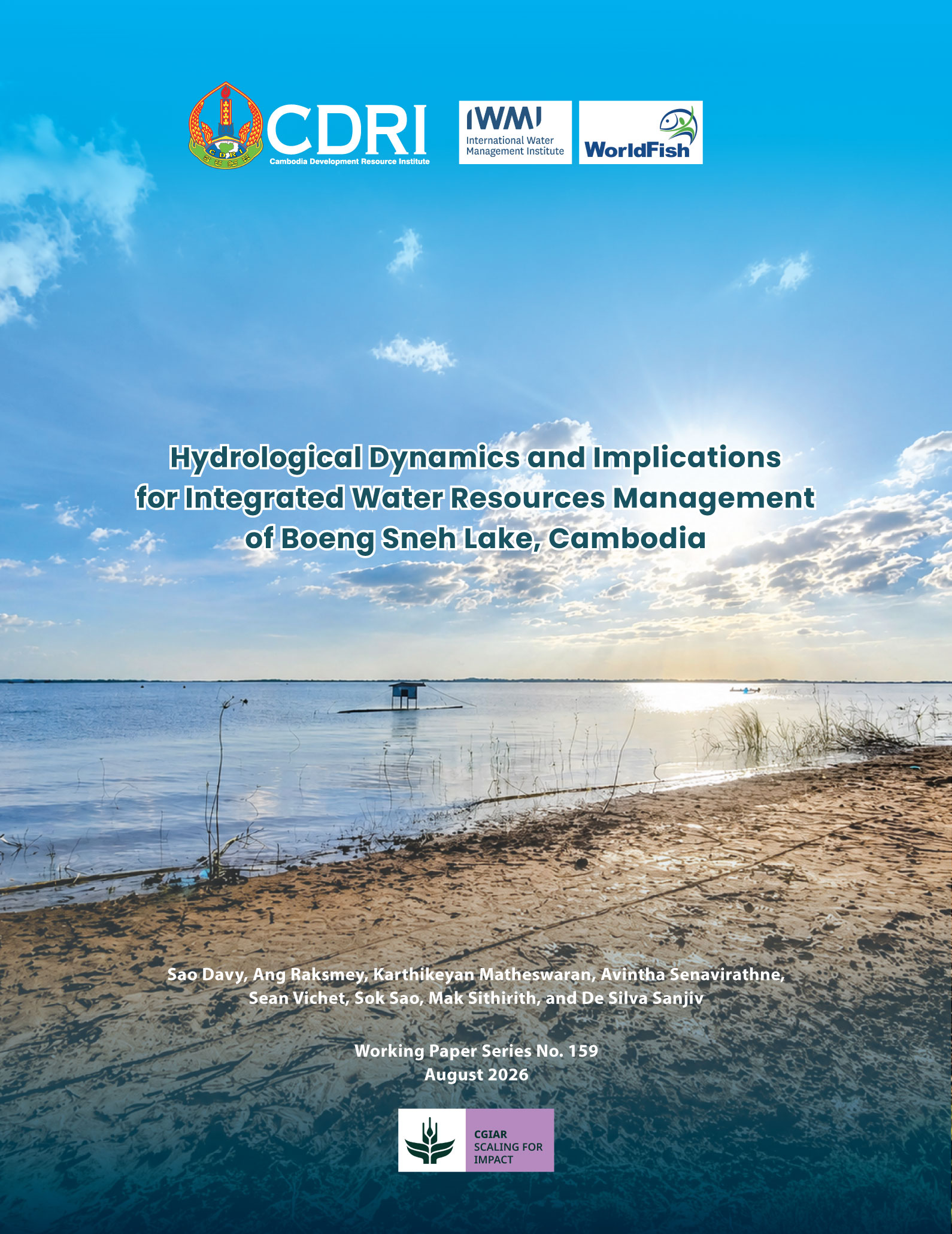
Hydrological Dynamics and Implications for Integrated Water Resources Management of Boeng Sneh Lake, Cambodia
Keyword: Boeng Sneh Lake, integrated water resources management, hydrological dynamics, water governance, Mekong Delta
Abstract/Summary
Boeng Sneh Lake
(BSL), a 3,924-hectare freshwater wetland in Cambodia’s Mekong Delta, is a
critical water resource that supports agriculture, domestic water supply,
fisheries, biodiversity conservation, and flood regulation. This study assessed
the lake’s hydrological dynamics and their implications for Integrated Water
Resources Management (IWRM) under growing pressures from climate variability
and increasing water demand. Using an integrated socio-hydrological approach,
this study combined a decade of meteorological data (2014–2024), remote sensing
analysis, a bathymetric survey comprising 121 systematic depth measurements
supplemented by 19 targeted measurements within the nine deep pools,
stakeholder consultations, and field investigations conducted in 2025. The
findings revealed pronounced seasonal fluctuations in lake storage, with
wet-season volumes reaching 80–100 million m³ but declining to critical levels
of 5–15 million m³ during recent dry seasons, well below the operational
threshold of 27 million m³ required to sustain the domestic water supply and
ecological refugia. Expanding irrigation for triple-cropped rice and increasing
domestic water abstraction have intensified competition among water users,
threatening fisheries and ecosystem health in the region. This study highlights
the value of a Google Earth Engine-based monitoring platform and the District
Technical Working Group (DTWG) as innovative tools for evidence-based
collaborative water governance. It recommends a trigger-based water allocation
framework, demand management measures, enhanced hydrological monitoring, and
stronger institutional coordination to improve the resilience and
sustainability of BSL under future climatic and socioeconomic pressures.
DOI: https://doi.org/10.64202/wp.159.202608
Related Publications
From Serial Discontinuity to Socio-ecological Resilience: A Conceptual...
08-Oct-2026
River ecosystem discontinuity and dysconnectivity are significant concern in transboundary river basins. Anthropogenic i...
The Political Ecologies of Managing Cambodia’s Tonle Sap Fisheries
11-Aug-2026
Situated in Cambodia, the Tonle Sap Lake (TSL) is the largest freshwater lake in Southeast Asia and the Mekong River Bas...
Strengthening and Localising Data for Inclusive and Climate-Resilient...
26-Jun-2026
Boeng Sneh Lake is a crucial freshwater ecosystem supporting rice farming, fisheries, water supply, and climate resili...