Centre for Natural Resources and Environment
The Centre for Natural Resources and Environment (CNRE) conducts policy-oriented and academic researches, focusing on climate change, resource governance, energy, and environmental sustainability. The centre generates evidence-based knowledge through rigorous researches using various methods including integrated modelling techniques, social-ecological system analyses, economic experiments, surveys and in-depth qualitative analysis. The research findings are shared widely among local and international partners, practitioners, and policy makers through publications, policy dialogues, and dissemination workshops. Our researches provide reliable information and scientific evidence for decision makers to make relevant policies, especially contributing to the Royal Government of Cambodia’s rectangle strategies on Angle 4: inclusive sustainable development, sustainable management of natural resources and culture, ensuring environmental sustainability, and primitive response to climate change.
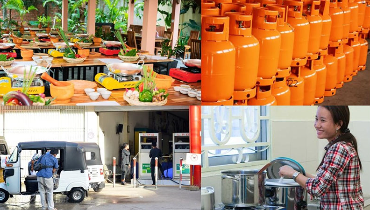
Survey on LPG Consumption Situation in Cambodia
The Economic Research Institute for ASEAN and East AsiaIn Cambodia, the source of fuel for households from liquefied petroleum gas (LGP) accounts for 56 per cent of urban settlements and 11 percent of rural residents, and it ranks second after firewood and charcoal. The source of elec...
Mekong Thought Leadership and Think Tanks Network
The Department of Foreign Affairs and TradeThe Mekong Thought Leadership and Think Tanks Network Program will address the challenges related to water and energy in the context of climate change impacting the most vulnerable and marginalised in society in Mekong countries....
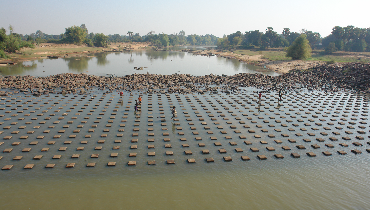
Asian Mega Deltas (AMD) Working Package 4 and Resilient Aquatic Foods in Food, Land and Water Systems (RAqFS) Working Pa...
International Water Management Institute (IWMI)The Asian Mega Deltas (AMD) program is one of the new OneCG initiatives that commenced in April 2022 and will run till at least 31 December 2024 (Phase 1). The One CG involves closer working modalities amongst the numerous CG Cent...
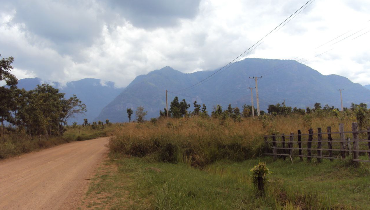
Renewable Energy and Climate Change Perceptions in Cambodia
The Economy and Environment Partnership for Southeast AsiaThis study hypothesizes that the reason for Cambodia’s moving toward a more fossil fuel-based energy could be due to the misperceptions or underestimated co-benefits of renewable energy in relation to the associated costs. If the...
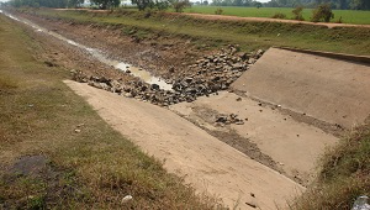
Managing Water Scarcity in the Mekong Region – Cambodia Water Scarcity Profile
Food and Agriculture Organization of the United NationsThe Cambodia water scarcity profile is a stock-taking exercise designed to understand what water scarcity challenges exist in the country and what is the current approach of government to managing water scarcity. The focus is on u...
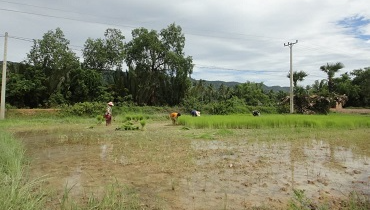
State of Gender Equality and Climate Change in Cambodia
Swedish International Development Cooperation AgencyUnder technical and financial support of UNEP and UNWOMEN, the assessment report is “a tool” to raise awareness about the benefits, advantages and need for gender-responsive climate action, analyse gendered impacts of climate c...
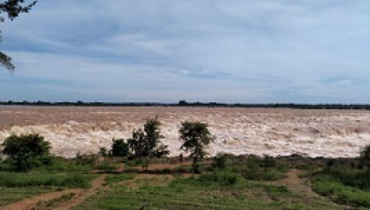
Challenges and Potentials of the Community Based Ecotourism in Livelihood Improvement, A Case Study in Preah Nimith CBET...
Swedish International Development Cooperation AgencyCommunity based ecotourism has been considered as an effective natural resource governance policy for both forest conservation and livelihood improvement, and increasing trend worldwide. The Royal Government of Cambodia has bee...
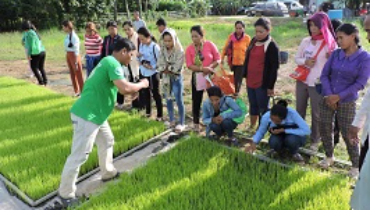
Gender-based Climate Change Adaptation and Disaster Risk Reduction in Cambodia’s Local Communities
Swedish International Development Cooperation AgencyUnder Sida’s fund, the study aims to provide policy inputs into the current gender equality and climate change responses. To strengthen women’s adaptive capacity and encourage them to actively participate in decision-making pro...
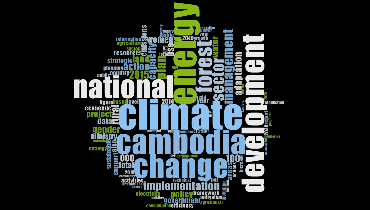
The State of Climate Change in ASEAN Region: Cambodia Country Report
Institute for Global Environmental StrategiesWorking to support Institute for Global Environmental Strategies (IGES), CNRE contributes to developing a comprehensive report on the status of climate change in the ASEAN region, which provides an overall outlook on the state...
There is no data list!
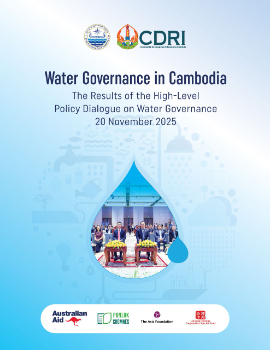
Water Governance in Cambodia: The Results of the High-Level Policy Dialogue on Water Governance, 20 November 2025
This report presents the results of the High-Level Policy Dialogue on Water Governance, convened in Phnom Penh on 20 November 2025 by the Cambodia Development Resource Institute (CDRI) in collaboration with the Ministry of Water Resources and Meteorology (MOWRAM). The dialogue addressed Cambodia’s pressing water security challenges, including climate change impacts, transboundary governance in the...
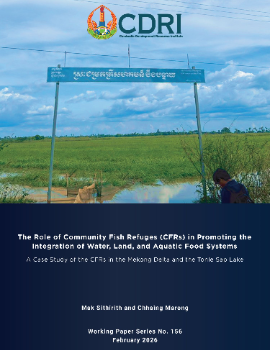
The Role of Community Fish Refuges (CFRs) in Promoting the Integration of Water, Land, and Aquatic Food Systems: A Case Study of the CFRs in the Mekon...
This working paper examines the role of Community Fish Refuges (CFRs) in promoting the integration of water, land, and aquatic food systems in Cambodia, drawing on six case studies in the Tonle Sap floodplain and Mekong Delta. Situated within rice-field and floodplain landscapes, CFRs function as dry-season refuges, wet-season spawning grounds, and hydrological connectors linking rivers, irri...
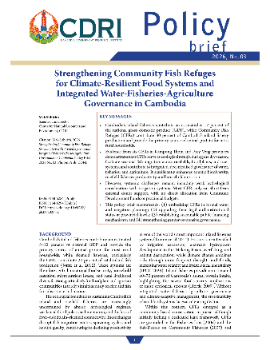
Strengthening Community Fish Refuges for Climate-Resilient Food Systems and Integrated Water-Fisheries-Agriculture Governance in Cambodia
Cambodia’s inland fisheries contribute an estimated 8–12 percent of the national gross domestic product (GDP), while Community Fish Refuges (CFRs) contribute 30 percent of Cambodia’s inland fishery production and provide the primary source of animal protein for most rural households.Evidence from six CFRs in Kampong Thom and Prey Veng provinces demonstrates that CFRs serve as ecological refug...
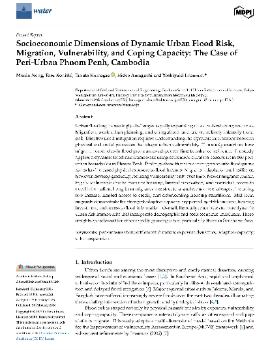
Socioeconomic Dimensions of Dynamic Urban Flood Risk, Migration, Vulnerability, and Coping Capacity: The Case of Peri-Urban Phnom Penh, Cambodia
Urban flooding increasingly challenges rapidly expanding cities in developing countries. Migration, weak urban planning, and unregulated land use collectively intensify flood risk. Effective flood mitigation requires understanding the dynamic interactions between physical and social processes that shape urban vulnerability. This study examines how migrant households in flood-prone areas adapt over...
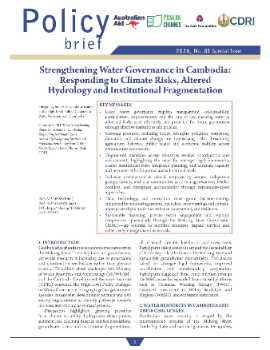
Strengthening Water Governance in Cambodia: Responding to Climate Risks, Altered Hydrology and Institutional Fragmentation
Good water governance requires transparency, accountability, participation, responsiveness, and the rule of law, ensuring water is allocated fairly, used efficiently, and protected for future generations through effective institutions and policies.Growing pressures, including floods, droughts, pollution, competing demands, and climate change, are intensifying risks, threatening agriculture, f...
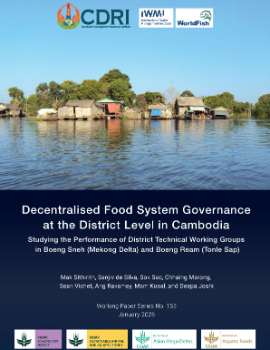
Decentralised Food System Governance at the District Level in Cambodia: Studying the Performance of District Technical Working Groups in Boeng Sneh (M...
This working paper examines decentralised food system governance at the district level in Cambodia through an assessment of District Technical Working Groups (DTWGs) established in Boeng Sneh (Mekong Delta) and Boeng Ream (Tonle Sap). These floodplain ecosystems are critical for rice production, fisheries, and rural livelihoods but face increasing pressures from fragmented governance, water c...
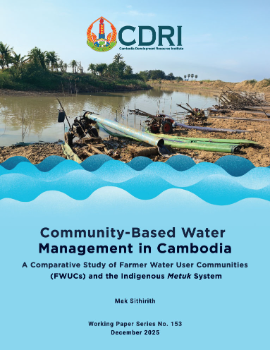
Community-Based Water Management in Cambodia: A Comparative Study of Farmer Water User Communities (FWUCs) and the Indigenous Metuk System
This working paper examines community-based water management in Cambodia through a comparative analysis of Farmer Water User Communities (FWUCs) and the indigenous Metuk system in the Tonle Sap floodplain. Drawing on qualitative case studies from Kakaoh Commune in Kampong Thom Province and Santey Village in Siem Reap Province, the study analyses governance design, legitimacy, ecological fit,...
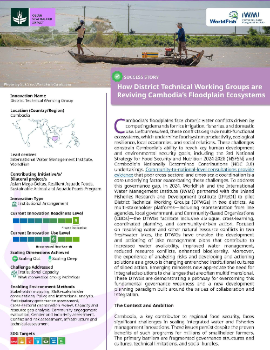
How District Technical Working Groups are Reviving Cambodia’s Floodplain Ecosystems
Cambodia’s floodplains face chronic water conflicts driven by competing demands for rice irrigation, fisheries, and domestic use. Left unresolved, these conflicts degrade multi-functional ecosystems, which undermine food system productivity, ecological resilience, local economies, and social relations. These challenges constrain Cambodia’s ability to reach key human development and environmental s...
Enhancing Flood Inundation Simulation Under Rapid Urbanisation and Data Scarcity: The Case of the Lower Prek Thnot River Basin, Cambodia
Flooding poses a major hazard to rapidly urbanising cities in Southeast Asia, and risks are projected to intensify under climate change. Accurate risk assessment, however, is hindered by scarcity of hydrological and topographic data. Focusing on the Lower Prek Thnot River Basin, a peri-urban catchment of Phnom Penh, Cambodia, the study applied the Rainfall–Runoff–Inundation model and systema...
Gender Dimensions of Climate-Induced Migration: Evidence from Three Provinces in Rural Cambodia
Climate change has negatively affected agricultural productivity, threatening the incomes and livelihoods of rural farmers. These pressures have led to both permanent and temporary migration. Migration trends are often internal or international, and their patterns vary significantly between men and women. Drawing on primary data from 377 migrant individuals across Kratie, Mondulkiri, and Stung Tre...