
News
29 June 2026The Middle-Income Trap in Cambodia: An Idea Whose Time Has Come
អន្ទាក់នៃប្រាក់ចំណូលមធ្យមនៅកម្ពុជា៖ គំនិតមួយដែលដល់ពេលត្រូវយកចិត្តទុកដាក់
សារគន្លឹះ
- បច្ចេកស័ព្ទ «អន្ទាក់នៃប្រាក់ចំណូលមធ្យម» សំដៅដល់កត្តារចនាសម្ព័ន្ធ ដែលជាឫសគល់នៃបញ្ហាប្រឈមដ៏ធំធេង ក្នុងការស្តារឡើងវិញ និងការរក្សាចីរភាពនៃកំណើនសេដ្ឋកិច្ចដ៏លឿន នៅប្រទេសកម្ពុជា។
- ក្នុងបរិបទនេះ វិទ្យាស្ថានបណ្ដុះបណ្ដាល និងស្រាវជ្រាវដើម្បីអភិវឌ្ឍន៍កម្ពុជា (CDRI) កំពុងចាប់ផ្ដើមធ្វើការសិក្សាស្រាវជ្រាវថ្មីដ៏សំខាន់មួយ ដែលផ្តោតលើភាពពាក់ព័ន្ធ និងផលប៉ះពាល់ផ្នែកគោលនយោបាយនៃអន្ទាក់នេះសម្រាប់ករណីកម្ពុជា។
- វិទ្យាស្ថាន CDRI កំណត់និយមន័យនៃ «អន្ទាក់» នេះថាជាស្ថានភាពមួយដែលដំណើរការនៃកំណើនសេដ្ឋកិច្ចមានលក្ខណៈខុសគ្នា នៅក្នុងប្រទេសដែលមានប្រាក់ចំណូលមធ្យម ធៀបនឹងប្រទេសដែលមានប្រាក់ចំណូលទាប។
- កន្លងមក កម្ពុជាបានកៀរគរធនធានសម្រាប់ការអភិវឌ្ឍ តាមរយៈការផ្លាស់ប្តូរកម្លាំងពលកម្មពីវិស័យកសិកម្មទៅកាន់វិស័យរោងចក្រឧស្សាហកម្ម ការផ្តល់ចំណេះដឹងអក្ខរកម្មមូលដ្ឋានដល់យុវជន និងការជំរុញការវិនិយោគឱ្យដល់កម្រិតខ្ពស់បំផុត។
- ប៉ុន្តែពេលនេះ កម្ពុជាអាចបត់បែនគោលនយោបាយបានតិចតួចណាស់ ដើម្បីសម្រេចបាននូវសមិទ្ធផលបន្ថែមទៀត។ យុទ្ធសាស្ត្រដែលធ្លាប់បានជួយជំរុញកម្ពុជាពីឋានៈជាប្រទេសមានប្រាក់ចំណូលទាប មកជាប្រទេសមានប្រាក់ចំណូលមធ្យម បានដើរមកដល់ទីទាល់ហើយ។
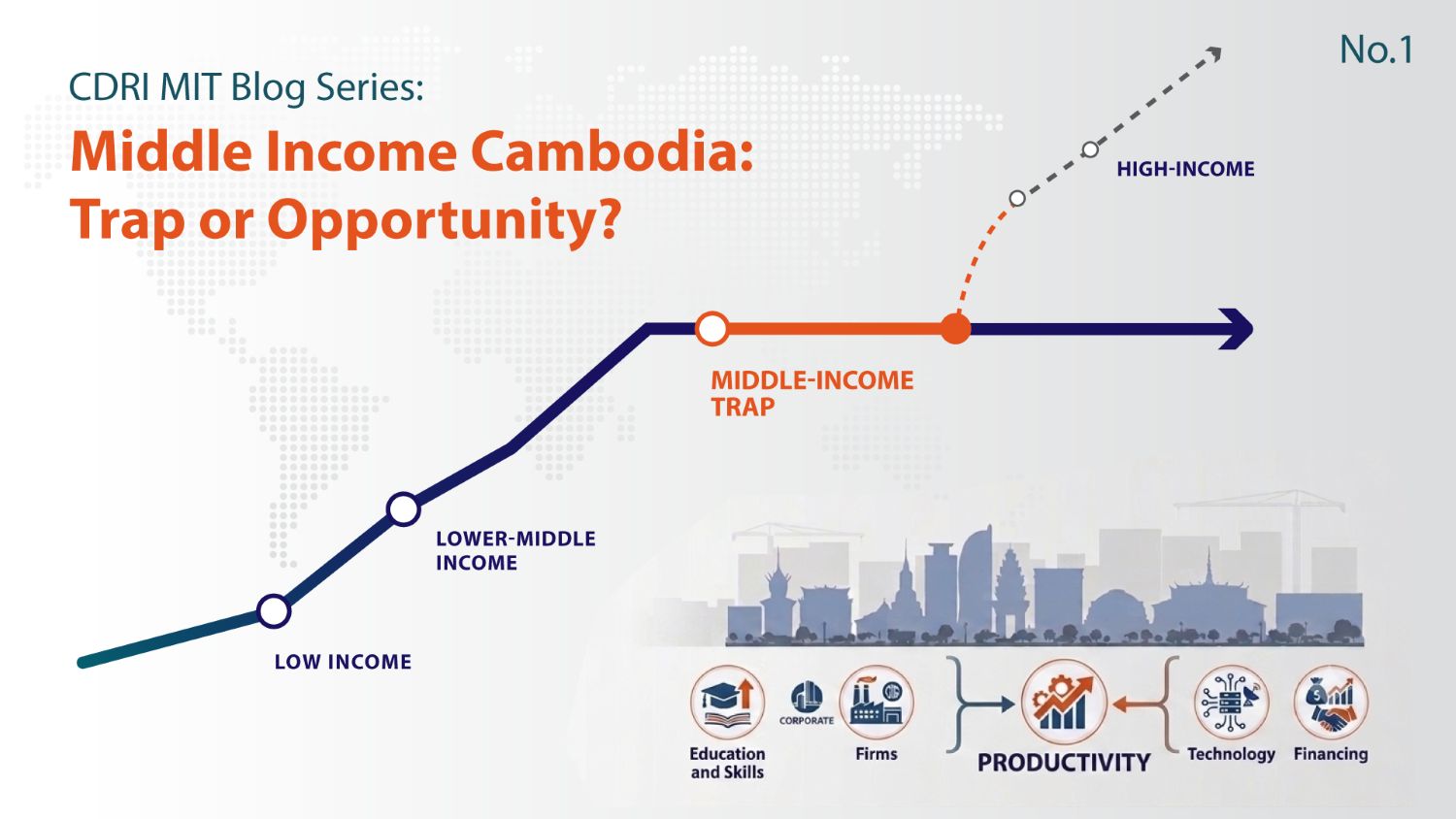
- ដើម្បីចាកចេញពីអន្ទាក់នេះ ពេលនេះកម្ពុជាចាំបាច់ត្រូវផ្តល់អាទិភាពដល់ការកែទម្រង់នានាដែលផ្តោតលើផលិតភាព។
Key Messages
- The Middle-Income Trap highlights those underlying structural factors which create deep challenges to resuming and sustaining rapid economic growth in Cambodia.
- The Cambodia Development Resources Institute (CDRI) is launching a major new research initiative focused on the relevance and policy implications of the Trap for Cambodia.
- At the CDRI, we define the Trap as a situation in which the process of economic growth works differently in middle-income countries compared to low-income countries.
- Cambodia has mobilised resources for development — moving workers from fields and households to the factory, providing the young with basic literacy, and boosting investment to very high levels.
- There is little policy space left to achieve any further gains; the strategy that helped drive Cambodia from low-to middle-income status has run out of steam.
- To escape the Trap, Cambodia now needs to prioritise reforms that focus on productivity.
Introduction
In 2025, the average income (GDP per
capita) in Cambodia reached USD2,870. Cambodia had secured the status of a
middle-income country, currently defined by the World Bank to be average
incomes in the range between USD1,136 and USD13,935. Ambitious plans by the
Royal Government of Cambodia have targeted, in Vision 2050, first
reaching upper middle-income status (USD4,496) by 2030 and then higher-income (USD13,935)
by 2050. Figure 1 shows that Cambodia has achieved this graduation as a result
of more than two decades of rapid economic growth.
In June 2023, the Cambodia Development
Resources Institute (CDRI) launched the Cambodia 2030
research “to evaluate Cambodia’s long-term growth
potential, with a specific focus on its aspiration to attain upper
middle-income status by 2030”. This research was organised jointly by CDRI,
the Ministry of Economy and Finance, and the Lowy Institute. The research is
summarised in an Overview Report
prepared by a team led by Eng Netra, comprising Roland Rajah, Caroline Hughes,
Muth Sumontheany, Chhorn Dina, and Jayant Menon. This blog introduces a new big
theme research project by the CDRI, ‘The Middle-Income Trap in Cambodia’, that
continues and extends this initiative, to think about the Trap and policy
priorities in Cambodia. This first blog provides a general introduction to the
Trap and its relevance for contemporary Cambodia. Future blogs in this series
will focus on the Trap, past, present, and future CDRI research, and policy
implications for Cambodia, under the broad rubric of achieving upper
middle-income status by 2030 and high-income status by 2050.
Figure 1: GDP Per
Capita (Current USD): Cambodia

Source: World Bank Development Indicators
(2026)
In 2020, Cambodia suffered a severe
economic recession due to the COVID-19 pandemic. And again, over the last two
years, Cambodia has been hit by an unprecedented series of economic shocks — rising
oil prices and higher domestic inflation, the border conflict and the resulting return
of nearly one million Cambodian migrant workers from Thailand, and a construction-real
estate slump that has increased non-performing loans in the banking system.
Organisations from CDRI to the International Monetary Fund (IMF), World Bank,
and Asian Development Bank (ADB) are
forecasting a slowing of economic growth to 4 percent in 2026 and 2027. Will
Cambodia prove resilient and bounce back to 7 percent growth or will slower
economic growth prove to be the ‘new normal’? The Middle-Income Trap highlights
those underlying structural factors which create deep challenges to resuming
and sustaining rapid economic growth in Cambodia.
The Trap defines a situation in which
middle-income economies, hitherto successful in escaping low-income status,
find it much harder to sustain the rapid economic growth necessary to escape
and attain high-income status.
The
Middle-Income Trap: An Idea Whose Time Has Come
In
2004, Geoffrey
Garrett published a short piece in the Foreign Affairs
journal suggesting that middle-income countries had not found a niche in the
global economy; they were struggling against low-wage competition and high-tech
competition from poorer and richer economies respectively. In 2007, Indermit
Gill and Homi Kharas coined the phrase ‘middle-income trap’ in research
examining how economic growth could be sustained in East Asia amidst the
dislocating rise of China. The idea of the Trap surged
in popularity in 1997–98 as the Asian Financial Crisis
appeared to derail the growth prospects of a swathe of middle-income countries.
Over the last twenty years, the Trap has become a staple topic of research at
the World Bank, the ADB, and the Organisation for Economic Co-operation and
Development (OECD), as well as of reporting in the Financial Times, the Wall
Street Journal, and the Economist. In 2024, there were 108
middle-income countries, including China in 1997 and India in 2007, containing 75 percent of
the world’s population, 40 percent of global economic activity, and more than
60 percent of those people in extreme poverty. The Trap has become part of the toolkit of
economists; every growth boom discussion, from China after 1980, African countries after
2000, and now Cambodia, about the sustainability of rapid economic
growth revolves around the framework of the Trap. The arbiter of global economic debate, the World Bank, provided a
contemporary seal of approval by dedicating the Trap as the theme of its World
Development Report in
2024.
The Big
Problem: Divergence Big Time
The
ultimate rationale for thinking about the Trap is the enduring failure of most
of the world to graduate to high-income status. To paraphrase the memorable 1997 expression from Lant
Pritchett,
since the onset of modern economic growth in the global economy since 1870,
there has been ‘divergence: big time’. Those few countries that attained
industrial and economic leadership in the 19th century still, mostly monopolise
the list of developed countries in 2025. Figure 2 shows that high-income (dark green)
remained largely confined to Europe and its offshoots in North America, and
Australasia. Japan, South Korea, and Singapore are among the few countries to
have graduated from middle-income status over the last century.
Figure
1: Divergence Big Time

Source: Our World in Data
(2026)
Some simple arithmetic
shows how decline in economic growth rates in Cambodia will have a dramatic
impact on the speed at which Cambodia converges with high-income countries. The
US has a GDP per capita of around USD90,000 per person and is growing at around
1.8 percent per annum. If Cambodia manages to sustain growth at 8 percent
(broadly what has been achieved over the last two decades), it will take
Cambodia 58 years to catch up with US income levels. If growth drops to 4
percent per annum (as many have forecasted), it will take 165 years; if growth
slows even further to 2 percent per annum, it will take 1,811 years.
The
Middle-Income Trap: Confusing Definitions
The
Trap has been defined in numerous, confusing, and often contradictory ways.
Some definitions revolve around comparative
descriptions,
often of stories of sustained growth in Asia and economic stagnation in Latin America.
Latin America has become stuck, its wages too high to compete with low-wage
economies in manufactured exports, and its productivity too low to compete with
advanced countries in high-skill services or manufacturing; China is often part
of this conversation —
whether the country can upgrade technology faster than growing labour shortages
put upward pressure on wages.
Often scholars use fixed income thresholds, usually
those of the World Bank, to count the number of countries entering and exiting
middle-income status. Jesus Felipe and others used
a dataset of 124 countries between 1950 and 2010, and found that there were
only three high-income countries (Kuwait, Qatar, and the UAE) in 1950. By 2010,
this club had increased to a membership of 34 countries, a net graduation rate
of 31 countries in 60 years. Others have looked at average incomes relative to the US and
defined the Trap in terms of whether countries have reached 50 percent or 60
percent of average incomes in the US. Other definitions revolve around testing whether transitions from
middle-income to high-income status are less common than other transitions, low
to middle-income for example; whether it takes longer to graduate from
middle to higher-income status today than it has been over the last century.
The
Middle-Income Trap: How We Understand it at CDRI
At CDRI,
we use a simple, pragmatic understanding of the Trap that revolves around the
idea that the process of economic growth works differently in a middle- compared
to a low-income country. An important implication of our definition is that
those policies that supported rapid economic growth and drove the transition
from low to middle-income status in Cambodia will stop working so well.
There is
substantial evidence that shows how the pace of economic growth tends to slow
down once a country reaches middle-income status. Barry
Eichengreen found
that economic growth tends to slow down as a country reaches average income
levels of USD11,000 and USD15,000. The World
Bank notes that growth
slowdowns are more frequent in middle than low or high-income countries; with
slowdowns occurring when an economy reaches around 10 percent of the income of
the lead economy. With a GDP of around 3 percent that of the US, Cambodia is
still some way below the income level when growth slowdowns become the norm.
The
Middle-Income Trap: Why it is Relevant for Cambodia Today
From the Fields to the Factory: CDRI rightly notes that Cambodia has realised most of the one-off benefits from shifting out of low-productivity agriculture into low-skilled jobs in labour-intensive manufacturing. CDRI research shows that today only 15.5 percent of Cambodia's GDP is accounted for by agriculture, while industry (including manufacturing and construction) has increased from 21.5 percent to 42 percent from 2020 to 2022. There are few historical examples of industry reaching any higher shares of GDP. By comparison, the peak shares of manufacturing were 35 percent in the UK (1950s), 48 percent in China (1980), 25 percent in the US (1970s), and 33 percent in Germany (1991).
Getting Behind the School Desk: While adult literacy remains relatively low at around 72 percent in 2023, youth literacy (age 15–24) has reached around 96 percent in the same year, and the net enrolment rate in primary school is around 90 percent.
From
the Household to the Factory: Recent
World
Bank data shows that Cambodia’s labour force
participation rate reached 82 percent of the total population. Women also play an
important role in the economy; female labour force participation has reached 74
percent — about double the average prevailing in other lower middle- income
countries. This reflects the one million jobs in manufacturing that Cambodia
has created, mainly for young, unskilled women in the textile sector. ILO
data shows that people also work long hours, with
an average of almost 50 hours per week. There is little scope to increase
employment or working hours even more.
The
End of the Labour Surplus: CDRI
research shows that real wages for low-skilled workers
have risen rapidly over the past decade as the supply of cheap labour from the
countryside or the households has reached its limits.
Mobilising
Resources for Investment: The share
of investment in GDP increased from 17 percent in 2000 to 38
percent in 2022. Few countries in history have ever sustained a higher rate.
Conclusion
Cambodia
has successfully mobilised resources for development — moving workers from
fields and households to the factory, providing the young with basic literacy, and
boosting investment to very high levels. As noted above, although Cambodia
remains below the income level where growth slowdowns can be expected, the
dramatic success of Cambodia in mobilising resources for development means that
diminishing returns to good macroeconomic policy are increasingly likely. There
is little policy space left to achieve any further gains. The strategy that
helped drive Cambodia from a low-to a middle-income status has run out of
steam.
As ongoing
CDRI research shows, to escape the Trap, Cambodia now needs to prioritise key reforms
targeted at education and skills, firms, technology, and financing that enable
the country to shift to a productivity-led growth path.
Look
out for our second blog, The Middle Income Trap in Cambodia: Diminishing Returns from Good Macroeconomic Policy?
Authors:
Prof Dr Matthew McCartney, Chief
Economist, CDRI
Ms HOUY Sivly, Research Assistant, CDRI’s Centre for Development Economics and Trade
Mr NITH Kosal, Research Associate, CDRI’s Centre for Development Economics and Trade
Related News
CDRI Board of Directors Meeting
04 November 2020The Board of Directors (BoD) of the Cambodia Development Resource Institute (CDRI) met at a virtual meeting on 3rd November 2020. All 10 existing BoD members attended and actively engaged in the deliberation and comments. For further information about CDRI BoD, please visit CDRI...
CDRI Deliveries Keynote at National Conference on Land and Natural Resources Governance
27 October 2020CDRI Senior Management was invited to deliver a key-note on the Land and Natural Resources Governance at the National Conference on Tuesday, October 27, 2020, at the Bassac II. It was attended by over 150 participants from the provinces, key ministries and departments, and repres...
Training on Introduction to R for Quantitative Data Analysis
04 February 2021In collaboration with The Asia Foundation and under financial support from the Australian Department of Foreign Affairs and Trade (DFAT), the Centre for Educational Research and Innovation (CERI) has organizing a three-day intensive workshop on “Introduction to R for Quantitative...