
Use of Hydrological Knowledge and Community Participation for Improving Decision-making on Irrigation Water Allocation
This study explores how hydrological knowledge and community participation can enhance decision-making in irrigation water allocation in Cambodia’s Stung Chrey Bak catchment. Conducted under the Water Resources Management Research Capacity Development Programme (WRMRCDP), the research integrates hydrological analysis with participatory learning...
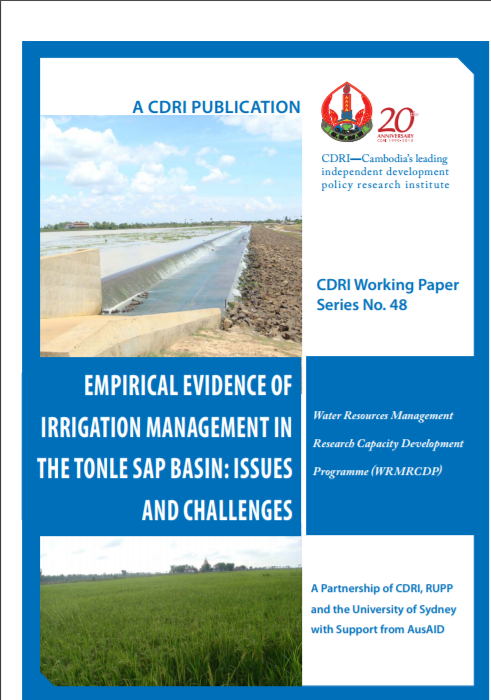
Empirical Evidence of Irrigation Management in the Tonle Sap Basin: Issues and Challenges
This working paper, published by the Cambodia Development Resource Institute (CDRI), presents an in-depth empirical assessment of irrigation management in Cambodia’s Tonle Sap Basin. It explores the critical role of irrigation in enhancing agricultural productivity in a country where 80 percent of the population relies on farming, primarily rice cu...
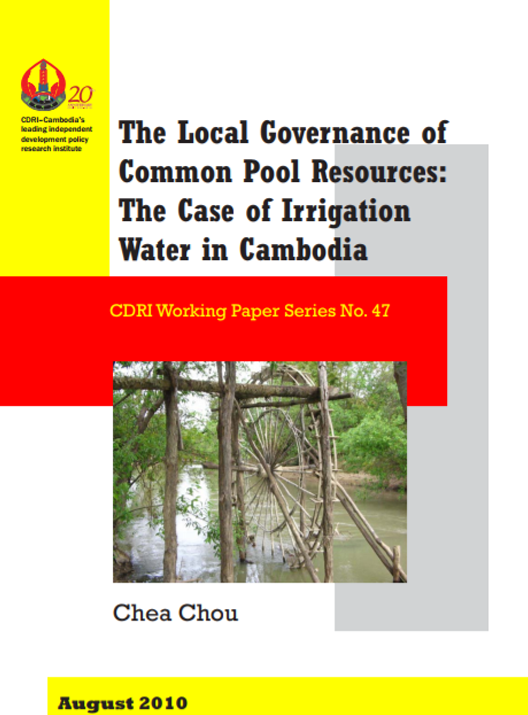
The Local Governance of Common Pool Resources: The Case of Irrigation Water in Cambodia
The study seeks out the factors that enable or constrain the good governance of common pool resources in Cambodia, using irrigation water as the case for analysis. It explores the dynamics of community-based natural resource management (CBNRM) and decentralised natural resource management (DNRM) from a local perspective and how these two approa...
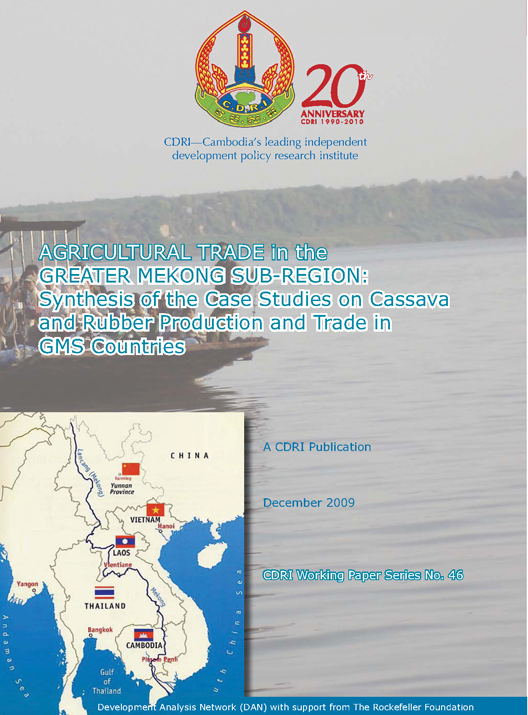
Agricultural Trade in the Greater Mekong Sub-Region: Synthesis of the Case Studies on Cassava and Rubber Production and Trade in GMS Countries
Agriculture creates a sense of commonality and connection among the countries of the Greater Mekong Subregion (GMS); however, its contribution to regional economies varies, being huge in Laos and Cambodia and much smaller in China, Thailand, and Vietnam. This paper summarises and synthesises the five country case studies, undertaken by the GMS Deve...
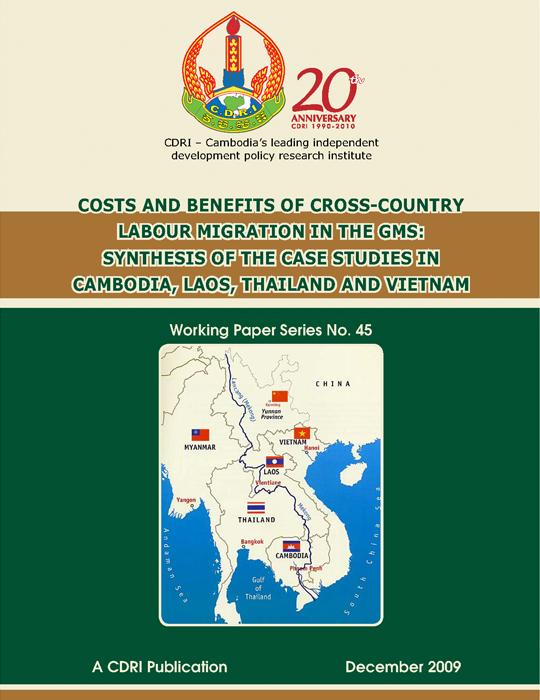
Economic Costs and Benefits of Cross-country Labour Migration in the GMS: Synthesis of the Case Studies in Thailand, Cambodia, Laos and Vietnam
There is growing interest in promoting cooperation in the Greater Mekong Subregion (GMS), comprising Cambodia, Laos, Myanmar, Thailand, Vietnam and Yunnan province of China, where socioeconomic development varies widely between countries. Job creation in the worse-off countries does not keep pace with increases in the labour force. Due to the highe...
Costs and Benefits of Cross-border Labour Migration in the GMS: Cambodia Country Study
Most Cambodian migrants travel by illegal or informal routes, mainly to Thailand, as the legal option is costly and inconvenient. Government agencies face a huge challenge in managing this growing labour migration. Since the creation of productive jobs does not keep pace with the number of new entrants to the labour force, the pressure to emigrate...
Agricultural Trade in the Greater Mekong Sub-region: The Case of Cassava and Rubber in Cambodia
Cambodia’s agricultural sector accounted for 27 percent of GDP in 2007 and employed about 56 percent of the total labour force, especially the poor. Aware of the importance of agricultural trade for economic growth and poverty reduction, the government’s approach has been to enhance agricultural exports while developing the sector. This study exami...
Leadership in Local Politics of Cambodia: A Study of Leaders in Three Communes of Three Provinces
Using the state-society gap as its assumption and point of departure, the study seeks to identify different kinds of local leaders (including women leaders) and their associated characteristics and elements of legitimacy in order to see whether and how they can help bridge this gap, in the midst of the decentralisation and deconcentration refor...
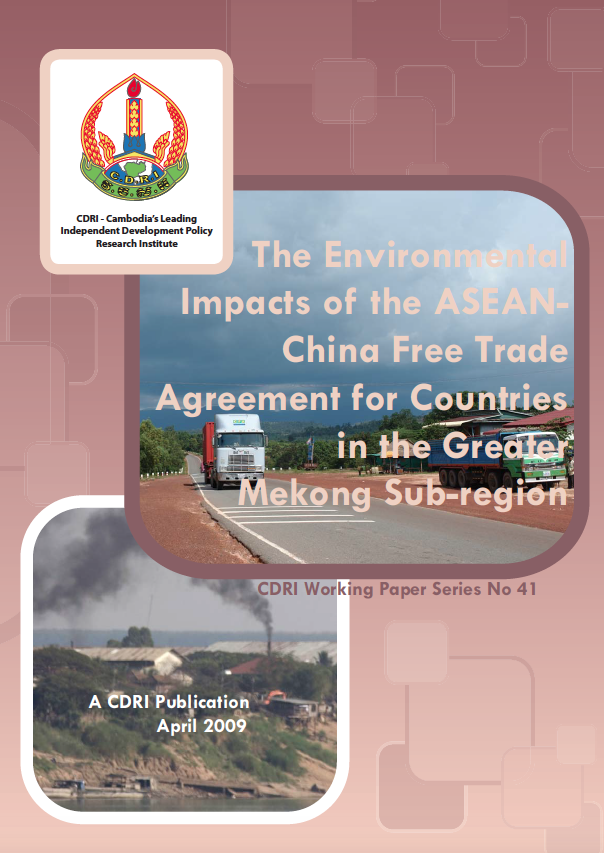
The Environmental Impacts of the ASEAN-China Free Trade Agreement for Countries in the Greater Mekong Sub-region
This study examines the environmental implications of the ASEAN-China Free Trade Agreement (ACFTA) for countries in the Greater Mekong Sub-region (GMS), with a particular focus on Cambodia. It explores how trade liberalization under ACFTA has influenced trade flows and environmental outcomes, using pollution intensity as a proxy for environment...
Accountability and Human Resource management in Decentralised Cambodia
This working paper explores the complexities of accountability and human resource management (HRM) within Cambodia’s civil service, particularly in the context of decentralisation and deconcentration (D&D) reforms. It critically examines how centralised control, politicisation, and neo-patrimonial governance structures undermine sub-national accoun...