
KANAYAMA Yuki
Former Research Fellow
Yuki is a research fellow at the Centre for Development Economics and Trade, CDRI. His research interests lie in impact evaluations, with specific focus on gender and health economics. Prior to joining CDRI, he worked as a research assistant at Stockholm School of Economics, Hitotsubashi University, Keio University, and JICA Research Institute. He has published several academic papers in peer-reviewed international journals in economics and public health. He received his master’s degree in economics from Stockholm School of Economics and bachelor’s degree in economics from Keio University.

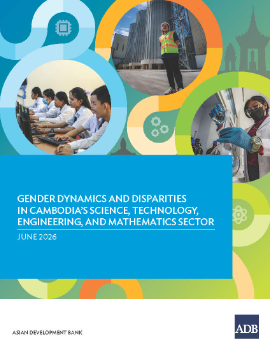
This report examines the persistent gender disparities in science, technology, engineering, and mathematics (STEM) education and employment in Cambodia, focusing on the systemic and structural barriers that limit women’s participation and progression in these fields. Despite increasing female enrollment in postsecondary education, women’s represent...
Gender gaps in digital adoption are mainly linked to structural factors affecting business scale rather than gender-specific technology barriers. When firm size is comparable, men and women owners show similar rates of digital adoption.Barriers to digital adoption for MSMEs include limited information, skill shortages, uncertain economic benefits,...
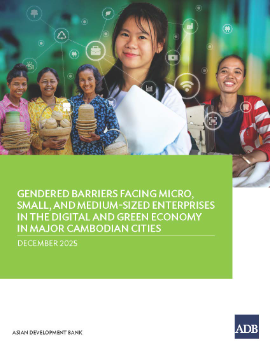
Drawing on extensive data and stakeholder insights, it reveals how unequal access to knowledge, finance, and networks can hold back enterprises owned by women. The report sets out targeted policy recommendations for inclusive economic development where women entrepreneurs are empowered to lead in the digital and green economy.For the full report, p...
Although the agriculture sector in Cambodia was initially considered less vulnerable to the COVID-19 pandemic, cassava farmers experienced severe economic hardship due to the increase in input prices, fluctuations in output prices, and challenges in infrastructure development. However, these aggregate impacts hide the disproportionate repercussions...

Co-residence with parents may decrease domestic or childcare responsibilities for women when their parents share household duties; however, the reverse may happen as parents age, leading to increased domestic responsibilities when older parents require more care. In our study, using the General Population Census of Cambodia 2019, we investigate how...
Despite the vast literature on birth-order effects in developing countries, there has been little research on their long-term changes. This study uses three population censuses of Cambodia to investigate how birth order affects educational attainments and how its effects changed over time. We estimate regressions with family fixed effects and cohor...
Research from developed nations has shown that later-born children tend to have worse outcomes in terms of health, nutrition, and education. However, evidence from developing countries remains mixed. In our research, using data on 423,848 individuals in Cambodia, we investigate how birth order affects not only education but also occupationa...
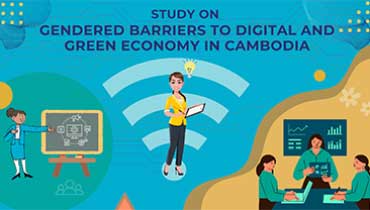
Micro, small, and medium-sized enterprises (MSMEs) often face challenges in utilizing digital technologies despite the vital roles of these technologies in business development. In particular, female-led MSMEs are less likely to use digital technologies. Previous studies have identified several barriers to digital technology adoption such as poor i...

The Cambodia STI roadmap aims to have 50% of university graduates majoring in STEM subjects, with 40% of those graduates being women, by 2030. Despite the government's efforts to promote STEM education and careers, the number of students majoring in STEM, particularly female students, remains very low compared to other countries in the region. Stud...