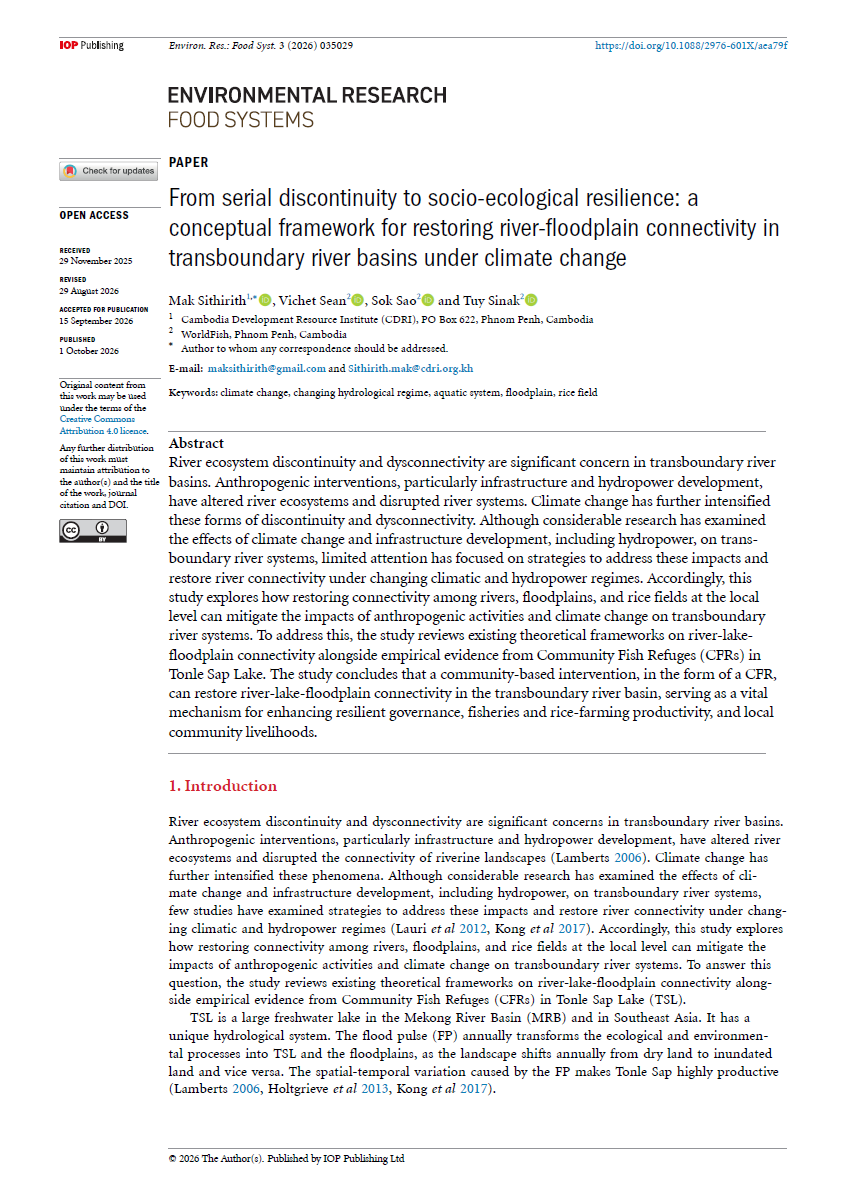
From Serial Discontinuity to Socio-ecological Resilience: A Conceptual Framework for Restoring River-Floodplain Connectivity in Transboundary River Basins under Climate Change
Abstract/Summary
River ecosystem discontinuity and dysconnectivity are significant concern in transboundary river basins. Anthropogenic interventions, particularly infrastructure and hydropower development, have altered river ecosystems and disrupted river systems. Climate change has further intensified these forms of discontinuity and dysconnectivity. Although considerable research has examined the effects of climate change and infrastructure development, including hydropower, on transboundary river systems, limited attention has focused on strategies to address these impacts and restore river connectivity under changing climatic and hydropower regimes. Accordingly, this study explores how restoring connectivity among rivers, floodplains, and rice fields at the local level can mitigate the impacts of anthropogenic activities and climate change on transboundary river systems. To address this, the study reviews existing theoretical frameworks on river-lake-floodplain connectivity alongside empirical evidence from Community Fish Refuges in Tonle Sap Lake. The study concludes that a community-based intervention, in the form of a community fish refuge, can restore river-lake-floodplain connectivity in the transboundary river basin, serving as a vital mechanism for enhancing resilient governance, fisheries and rice-farming productivity, and local community livelihoods.
Get the full article at: https://doi.org/10.1088/2976-601X/aea79f
Related Publications
The Political Ecologies of Managing Cambodia’s Tonle Sap Fisheries
11-Aug-2026
Situated in Cambodia, the Tonle Sap Lake (TSL) is the largest freshwater lake in Southeast Asia and the Mekong River Bas...
Hydrological Dynamics and Implications for Integrated Water Resources...
04-Aug-2026
Boeng Sneh Lake (BSL), a 3,924-hectare freshwater wetland in Cambodia’s Mekong Delta, is a critical water resource tha...
Strengthening and Localising Data for Inclusive and Climate-Resilient...
26-Jun-2026
Boeng Sneh Lake is a crucial freshwater ecosystem supporting rice farming, fisheries, water supply, and climate resili...