
The Role of Rural Credit during the Global Financial Crisis: Evidence From Nine Villages in Cambodia
This paper studies the role of rural credit in Cambodia during the global financial and economic crisis that began in 2008. The paper briefly reviews rural credit in Cambodia during 2008, analyses rural households’ formal and informal credit demand during the crisis and proposes policy options. The results suggest that household dema...
The Role of Income Diversification during the Global Financial Crisis: Evidence from Nine Villages in Cambodia
This paper uses four-period panel data covering the years 2001, 2004, 2008 and 2011 to analyse the roles of rural income diversification during the global financial crisis. Income diversification is commonly defined as a proportion of income derived from non-farm activities or the number of income portfolios. However, the use of such measures i...
Household Vulnerability to Global Financial Crisis and Their Risk Coping Strategies: Evidence from Nine Rural Villages in Cambodia
Although economic growth started to show signs of recovery in early 2010, a consumption shortfall was pervasive across Cambodian sample villages and household wealth statuses, reflecting the protracted effect of the global financial crisis up to March 2011. This paper aims to investigate the extent of rural household vulnerability and their use an...
Impact of the Global Financial Crisis on the Rural Labour Market: Evidence from Nine Villages in Cambodia
This report presents new work on the impacts of the global financial crisis on the rural labour market in Cambodia. The analysis uses a combination of descriptive statistics and econometric modelling with data from household surveys in nine rural villages to track labour market changes before, during and after the crisis and then assesses the m...
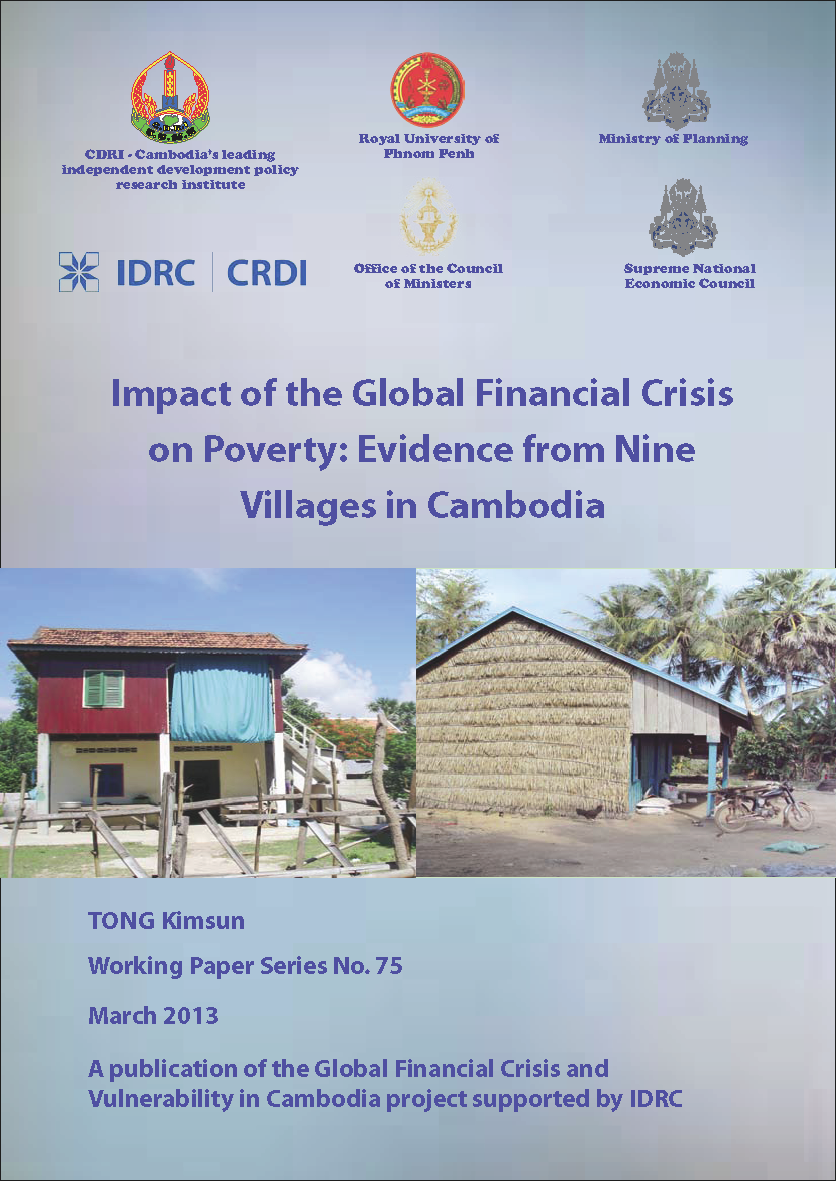
Impact of the Global Financial Crisis on Poverty: Evidence from Nine Villages in Cambodia
This paper investigates the impact of the global financial and economic crisis on Cambodian rural households, mainly focussing on trends in household consumption and poverty, i.e. the poverty headcount ratio, poverty gap and squared poverty gap, using four-period panel data covering the years 2001, 2004, 2008 and 2011. Descriptive statistics revea...
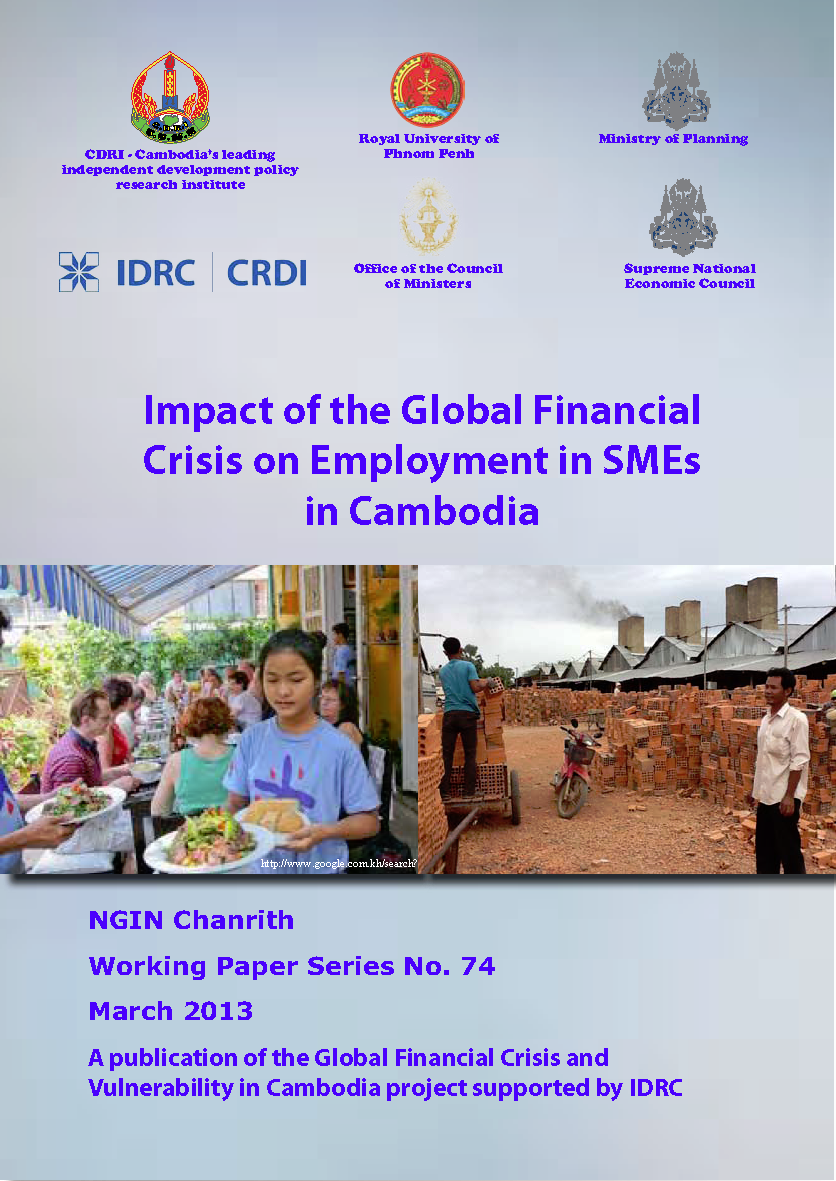
Impact of the Global Financial Crisis on Employment in SMEs in Cambodia
This chapter assesses how the global economic and financial crisis has affected employment in small- and medium-sized enterprises (SMEs) in the construction and tourism sectors in Phnom Penh municipality and Siem Reap province. Key areas of analysis are SMEs’ business performance, fixed assets value, and employment, and support received to c...
Government Response to Inflation Crisis and Global Financial Crisis
This paper takes stock of the domestic macroeconomic policy deployed in mitigating the highest inflation and lowest growth Cambodia had experienced since 1994. Fiscal and monetary policies were well-coordinated alongside a package of administrative measures to tackle soaring inflation resultant of the oil and food price hikes in 2007 and slow...
Impact of the Global Financial Crisis on Cambodian Economy at Macro and Sectoral Levels
Although the global economy is recovering from the financial and economic crisis that started in 2008, many countries have not returned to their pre-crisis growth rates. Cambodia is no exception. Despite its rich endowment of natural resources, especially minerals, oil and gas, the country still depends on a narrow growth base of just four sec...
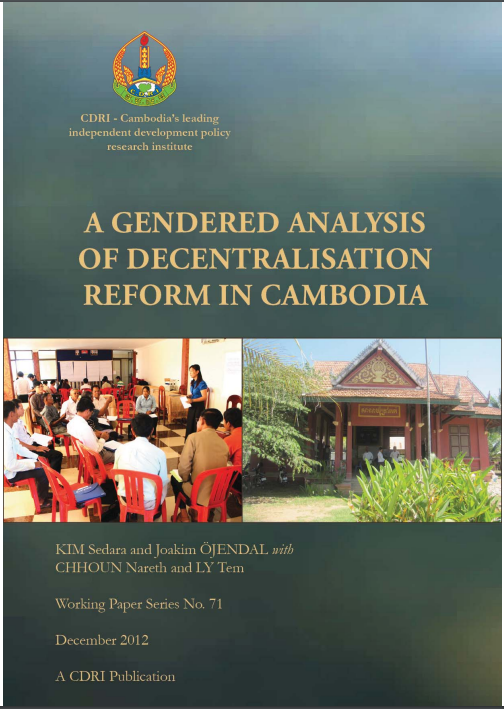
A Gendered Analysis of Decentralisation Reform in Cambodia
The commune/sangkat elections in 2002 and 2007 marked a significant step forward in Cambodia’s democratic decentralisation process. Decentralisation is the most deep-cutting public sector reform and the politically most important democratic development in Cambodia. The reform rearranges power structures, creates space for a more pluralistic pol...
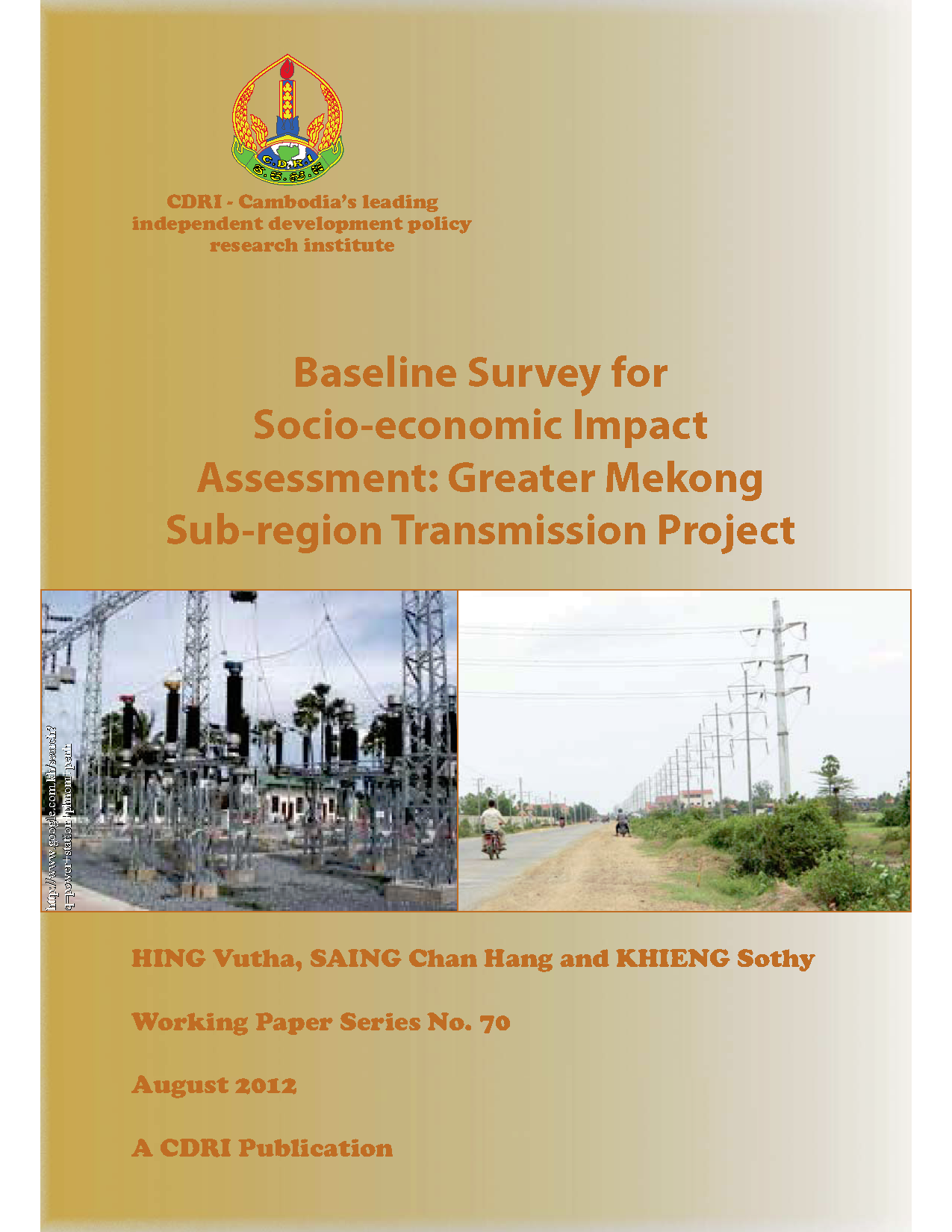
Baseline Survey for Socio-economic Impact Assessment: Greater Mekong Sub-region Transmission Project
This research project represents the first baseline socioeconomic survey that CDRI has conducted for the Greater Mekong Sub-region Transmission Project of Asian Development Bank. The study was designed to develop a set of comprehensive baseline demographic, social and economic as well as energy consumption indicators for the project. The tools...